

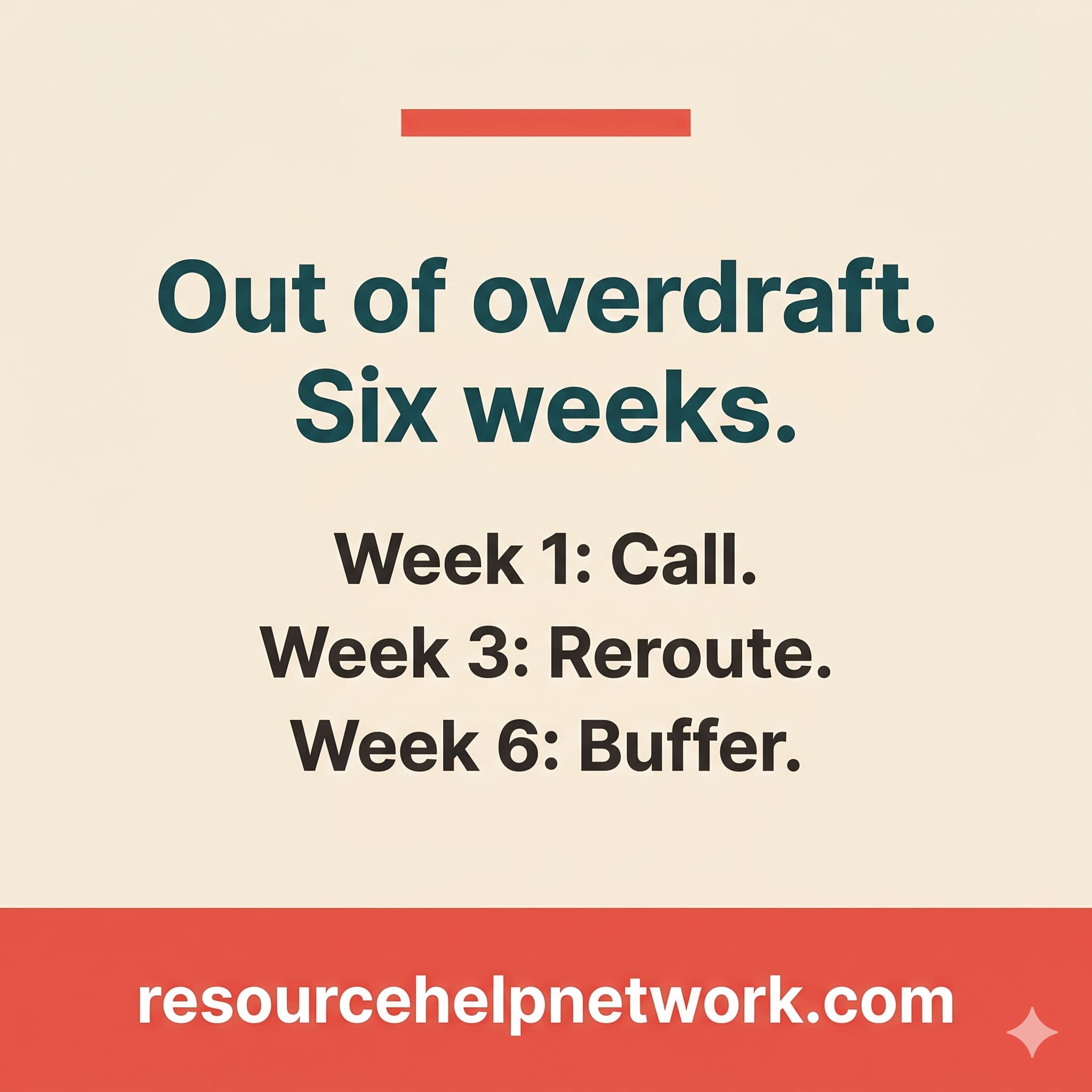
A negative $137 balance shows up on Friday afternoon. The auto-bill for the phone hit before Tuesday’s paycheck cleared, the bank charged a $32.50 overdraft fee, and now the next paycheck has to first patch the negative balance plus the fee before it covers anything else. By Wednesday the cycle has compounded again. CFPB data puts the average overdraft fee at about $32.50; roughly 9% of accounts pay more than ten overdraft fees a year, averaging about $380 annually for that group. Breaking the loop is a specific sequence of moves over six weeks that resets the cash flow and leaves a small buffer where the loop used to live.
The fastest way out of an overdraft loop is to call the bank in week one and ask for a one-time fee waiver and an alternative to overdraft coverage. Banks reverse roughly half of first-time waiver requests when the account is otherwise in good standing.
Week 1: the call that resets the math
The first move is a phone call to the bank’s customer service line, not the branch. Ask for two things in one call. First, a courtesy reversal of the most recent overdraft fee. Banks track these reversals and approve them roughly half the time when the customer asks directly and the account has been positive for most of the prior year. Second, ask to opt out of overdraft coverage on debit-card transactions. Federal Reserve Regulation E requires explicit opt-in for debit overdraft, and opting out means future debit transactions decline at the register rather than triggering a fee.
While on the call, ask the representative to confirm the next three pending charges and their post dates. The Consumer Financial Protection Bureau, the federal agency that regulates consumer banking, has flagged that transaction reordering is a primary driver of overdraft fee stacking, where a bank processes the largest debit first and lets four smaller debits trigger four separate fees. Knowing the order of pending charges lets you transfer cash to cover the largest one and stop the cascade.
If the bank refuses both requests, that itself is information. A bank that will not waive a single fee for a reasonably good customer is signaling that the account is not the right home long-term, and week three becomes the moment to switch.
Week 2: the reroute of fixed bills
In week two, identify every fixed debit that lands in the first ten days after payday. Phone bill, gym, streaming subscriptions, insurance premiums, and any auto-savings transfers. Move each one to the last ten days of the pay cycle, after both rent and groceries are accounted for. Most billers will accept a date change with one online request, no fee, no penalty.
The point is not to delay paying the bills. The point is to stop a clustered debit pattern that turns Tuesday morning into a balance roulette. A flat $1,800 landing every other Friday paired with $400 of clustered debits on the following Tuesday is the recipe that keeps the loop running. Spreading the same $400 across three weeks ends the loop.
There is no general federal overdraft-fee credit. If your bank offers a settlement-related credit or courtesy adjustment, confirm its terms with the bank before using it as cushion money. For broader context on building a buffer at thin starting margins, see Building an emergency fund on a tight budget.
Week 3: the second account or the bank switch
In week three, decide whether the current bank can be saved or whether to switch entirely. The fastest path out of a chronic loop is sometimes a second account at a no-fee online bank like Ally, Discover, or SoFi, where overdraft is structurally turned off and there are no monthly fees. Direct-deposit the paycheck into the new account and set the old account to receive only enough to cover bills posted from it.
If switching banks is too disruptive, ask the existing bank to add a savings account linked to the checking as overdraft protection. The transfer fee for using linked savings is typically $10 to $12, far less than a $32.50 overdraft fee. A linked savings with even $50 in it changes the math on every near-miss for the next year. For cash-flow-side levers that can also support the new pattern, see How cash-back apps can help save every month.
Week 4: the income skim that builds the cushion
Week four is when the cushion starts to grow. Set an automatic fixed-percent skim from every deposit, routed to a separate savings account. The Federal Reserve’s Survey of Household Economics and Decisionmaking consistently shows manual transfers happen far less often than the saver intends, so the skim has to run on autopilot.
A 5% skim on a $1,800 paycheck is $90 per pay period. After three pay periods that is $270, which covers two overdraft fees plus a small timing buffer. After six pay periods it is $540, which is roughly what most households need to permanently exit the loop.
By week six, the gap between paycheck arrival and the riskiest debit should be at least $250 of buffer in the checking account, with the cushion savings holding another two weeks of rent.
Week 5: the calendar lock-in
In week five, the goal is to make the new pattern survive a bad month. Put the rent date, the largest two debits, and the paycheck arrival on the same calendar with a notification two business days before the largest debit posts. If the buffer drops below the largest pending debit, call one biller to push that bill 14 days. Most major billers will grant a one-time 14-day extension on request, no fee, no late mark, when the customer calls before the due date. The push is a one-shot release valve, not a long-term tool. For how the late-bill conversation interacts with credit, see How to recover from a late payment on your credit.
Week 6: the buffer review and the new normal
By week six, three checkpoints confirm the loop is broken. The checking account ends each pay cycle with at least $250 above the largest single debit. The cushion savings holds at least one week of rent. Zero overdraft fees have hit in the past 28 days.
If those are true, freeze the system. Do not move bills back to their old dates and do not lower the skim percent. The new pattern works because every variable was tuned together. Changing one undoes the others. If the checkpoints are not true after six weeks, the usual reason is that the skim percent is too low for the income volatility. Bump 3% to 5%, or 5% to 8%, and run another four-week sequence.
Questions
Will the bank actually waive a first overdraft fee? Roughly half the time, yes, when asked directly by phone with an otherwise clean recent history. Online forms tend to get denied more often than phone calls. Ask politely, mention how long the account has been open, and request a one-time courtesy reversal.
What if my bank does not allow opting out of overdraft coverage? Federal Reg E requires that consumers be able to opt out of debit-card and ATM overdraft. If the bank refuses, file a complaint with the CFPB. Most refusals reverse within a week of a CFPB complaint being filed.
Can I do all six weeks at the same bank? Yes if the bank agrees to fee waivers and a linked savings account. If the bank refuses both, week three is the time to open a second account at a no-fee online bank and route the paycheck there.
Should I close my old checking account once the loop breaks? Not immediately. Keep the old account open for at least 60 days with a small balance to absorb any straggling debits or recurring charges you missed. Closing it too early can trigger missed-payment marks on auto-debit billers.
How does this compare to overdraft protection from a credit card? Linked credit card overdraft protection typically charges a cash-advance APR of 25% or higher plus a $10 transfer fee. A linked savings account is almost always cheaper. A credit card linkage is a backup of last resort, not a primary tool.
When the negative balance has compounded across multiple cycles, comparing fixed-rate personal loan offers can stop the bleeding faster than waiting on the next paycheck. Compare personal loan offers on NerdWallet.
FAQ Schema
Source: Public Law 119-10.