

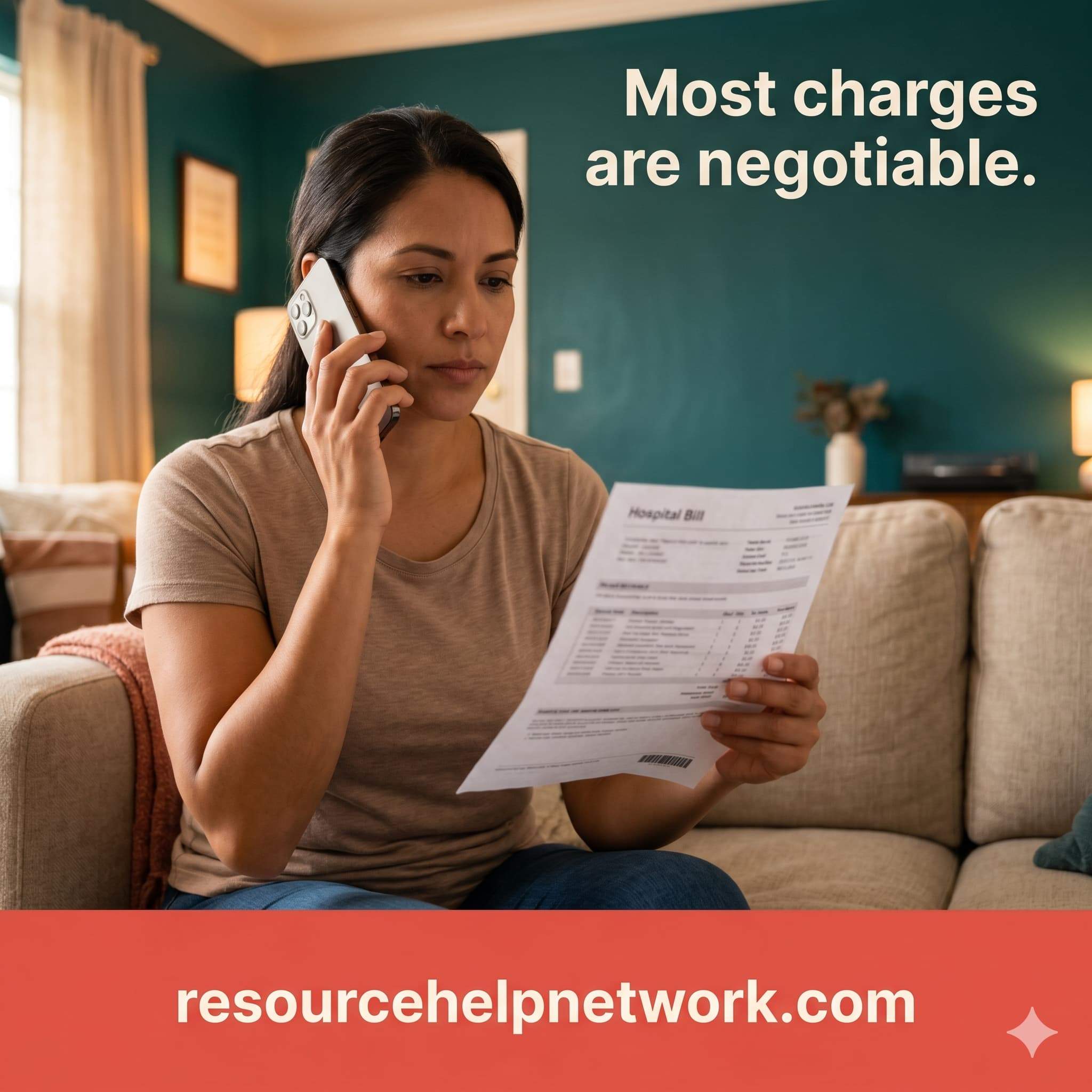
The bill arrives 47 days after the ER visit. Seven thousand four hundred and twenty dollars for an in-network procedure your insurance was supposed to cover. The explanation of benefits does not match the line items on the statement. There is roughly a 30-day window before this account moves to a collection agency, and the conventional advice to “just call and ask for a discount” lands on the floor of the billing department without a sequence behind it. Hospital bill negotiation works, but the order of calls determines whether the final number lands at 30% of the original or 70%.
A 2024 analysis from the Consumer Financial Protection Bureau (the federal agency that regulates consumer lending) estimated $220 billion in outstanding medical debt nationally. Most of those charges are negotiable, especially before the account leaves the hospital’s billing office.
Before any call: gather the four documents
The negotiation depends on documents that most patients never request. Without them, the conversation is a guess against a number the hospital chose.
The itemized bill is the first. Request it explicitly, because the original statement that arrives in the mail is typically a summary, not the line items. The itemized version lists Current Procedural Terminology and Healthcare Common Procedure Coding System codes, which is what every later call references. The explanation of benefits from your insurance is the second. Compare each EOB line to the corresponding bill line. Discrepancies are common and are often the leverage that pulls the first 10% to 25% off the bill. The hospital’s published charge master rate is the third, required by federal price transparency rules. It is usually buried on the hospital’s website but searchable. The fourth is the contracted in-network rate paid by your insurance, which is the floor the hospital actually accepts from the insurer for the same code. That spread, between charge master and contracted rate, is where most of the negotiation sits.
For broader context on how to keep an active medical-debt account from cascading into late fees, see How to set up a bill payment calendar to avoid late fees.
Call 1: Patient Advocate
The first call is to the hospital’s patient financial advocate or patient experience office, not the billing department. This is a different line of authority and the role is staffed for exactly this conversation. Walk through the EOB and the itemized bill side by side. Flag any duplicate charges, any charges for services not received, and any coding mismatches. Ask for an internal review of the flagged items. A typical outcome here is a 10% to 25% reduction when coding errors exist, and many bills have at least one.
End every call the same way. Ask for the name of the person you spoke with, ask for a reference or case number, and ask for written confirmation of any agreement to be sent by email or patient portal before any payment moves.
Call 2: Billing Department
The second call goes to the standard billing or accounts receivable department. The framing changes here. The question is not “can I get a discount” but “what is the cash-pay rate or financial hardship rate for this procedure code.” Both rates exist at most hospitals and are not always volunteered. The cash-pay rate is the rate the hospital quotes to uninsured patients who can pay in full, which is typically 30% to 50% below the charge master. The financial hardship rate is need-based and is documented after a short application.
A well-run call two reduces the bill by 30% to 50% from the original number, on top of any reductions already taken in call one.
Call 3: Charity Care Application
The third call introduces charity care, which is required by federal law for nonprofit hospitals under IRS Section 501(r). Income thresholds vary by hospital but commonly extend to 200% to 400% of the federal poverty level. Some hospitals also offer sliding-scale assistance up to 600% of the poverty level. The application typically takes 30 to 60 days to process and asks for tax returns, recent pay stubs, and proof of household composition.
A successful charity care application often produces a full or partial write-off rather than a percentage reduction. Even patients who assume they earn too much to qualify should apply, because thresholds run higher than most expect for households with children or significant medical expenses.
Call 4: Settlement Offer
If charity care does not apply, the fourth call proposes a lump-sum settlement on the remaining balance. The standard opening is 30% to 40% of what is owed, paid in full within 30 days, in exchange for the account being closed and reported as paid. Most hospital billing departments have authority to accept settlements between 50% and 70% of the remaining balance. The negotiation usually lands somewhere in that band.
Two rules are non-negotiable. First, never send a settlement payment without written confirmation of the agreement. Second, the settlement letter should explicitly state that the account will be reported as “paid in full” or “settled in full,” because the credit reporting language matters for any future credit decisions you face.
For state and nonprofit assistance pathways that often run alongside this step, see Nonprofit organizations that help with emergency bills and Negotiating medical bills with providers.
Call 5: Collector Negotiation If It Gets There
The fifth call is the fallback for accounts already routed to a collection agency. The economics shift sharply. Collection-agency purchase prices vary, so this article does not assign a national cents-on-the-dollar figure. That means a $7,000 bill was sold for between $280 and $700, and the collector profits at any settlement above their purchase price. A lump-sum offer of 25% to 40% is realistic at this stage.
Two cautions apply. First, never make any verbal acknowledgment that “validates” the debt before settlement language is in place, because in some states this can restart the statute of limitations clock. Second, get the agreement in writing on the collector’s letterhead before any payment, with explicit language that the debt will be reported as resolved or removed.
End every call with three things written down: the name of the person, a case or reference number, and email confirmation of any agreement before money moves.
Questions
What if the hospital will not negotiate at all?
Escalate. Ask for the billing supervisor by name, then the patient experience director if the supervisor declines. If the hospital is a nonprofit, the charity care application is a legal requirement and cannot be refused outright.
Should I pay anything before the bill is finalized?
No. Any partial payment can reset the negotiation baseline, and some hospitals interpret partial payment as acceptance of the full balance. Settle the number first, then pay according to the written agreement.
Will negotiating hurt my credit?
Negotiating itself does not hurt your credit. Settling for less than the full balance can be reported as “settled” rather than “paid in full,” which can show on the credit report. The nationwide credit bureaus exclude medical debt under $500 from consumer credit reports under their voluntary policy; this is not a current CFPB rule. court update.
How long do I have before this goes to collections?
Hospital billing cycles vary, but most accounts move to collections between 90 and 180 days after the first statement. Some hospitals send to collections at 60 days. The clock starts on the statement date, not the service date.
Can I do this without a patient advocate’s help?
Yes. The five-call sequence works for self-represented patients. Patient advocates and medical billing advocates can help with complex cases, especially bills above $20,000 or claims involving denied coverage, but they are not required.
Once the negotiated balance is set, financing the remainder with a fixed-rate personal loan is usually cheaper than carrying it on a hospital payment plan or a credit card. Compare personal loan options on NerdWallet.